Metrics, Calibration, Statistical Confidence, and Model Comparison
Teach learners how to choose, calculate, interpret, and challenge model performance metrics.
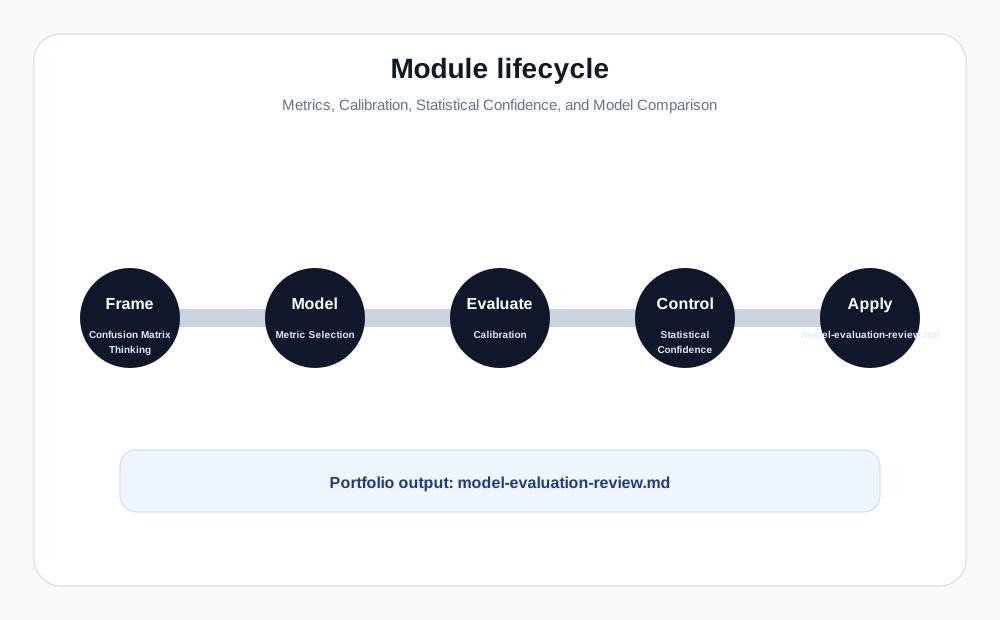
Metrics, Calibration, Statistical Confidence, and Model Comparison video briefing
A focused explanation of chapter 5, turning the AI testing theory into concrete validation checks.
Briefing focus
Module opening
This is a structured lesson briefing. Real video/audio can be added later as a media source.
Estimated time
9 min
- 1Module opening
- 2Learning objectives
- 3Mind map
- 4Scenario evidence breakdown
Transcript brief
Teach learners how to choose, calculate, interpret, and challenge model performance metrics. The briefing explains why the topic matters, walks through a failure scenario, and identifies the artefacts a tester should produce for evidence and auditability.
Key takeaways
- Connect the AI risk to a measurable test or monitor.
- Document the evidence needed for reproducibility and audit.
- Use the lab or scenario to practise the validation workflow.
Module opening
Teach learners how to choose, calculate, interpret, and challenge model performance metrics.
Audience. QA professionals reviewing model evaluation reports and release dashboards.
Why this matters. Metrics are persuasive, but easy to misuse. Testers need to know when a metric answers the real product risk and when it hides uncertainty or harm.
ISTQB CT-AI mapping. CT-AI 5.1-5.4, 9.4
Trainer note
Start with the scenario before the theory. Ask learners what evidence would make them confident, then use the module to build that evidence step by step.
Learning objectives
- Explain the core quality risk in metrics, calibration, statistical confidence, and model comparison.
- Select practical test evidence that supports an AI release decision.
- Apply the module concepts to a realistic QA scenario.
- Produce a portfolio artifact that can be reused in a professional AI testing context.
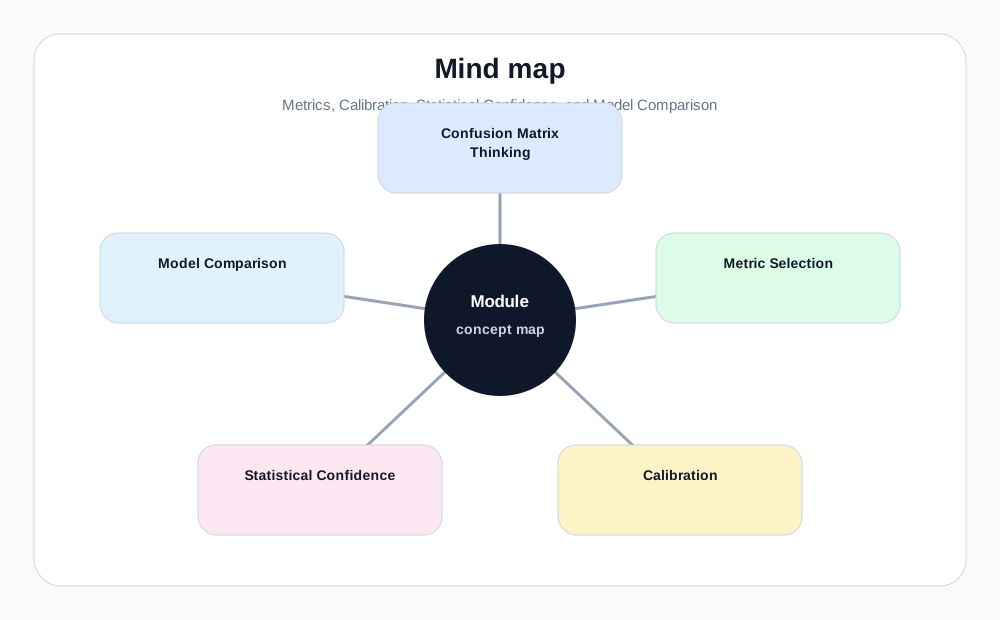
Mind map
Real-life scenario · FinTech
The fraud model that looked better on the wrong metric
Situation. A classifier flags transactions for review. ROC AUC improved, but precision at the operational review capacity dropped, creating more false alerts than analysts could handle.
Lesson. AI testing is strongest when risks, examples, evidence, and release decisions are connected.
Scenario evidence breakdown
| Scenario element | Detail |
|---|---|
| Product/System | Card fraud detection |
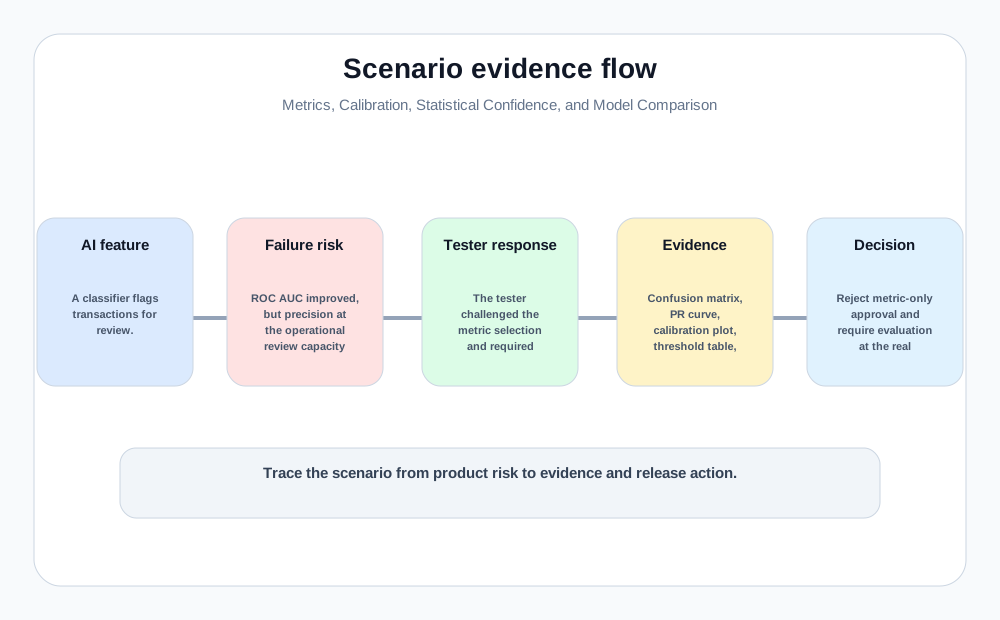
| AI feature | A classifier flags transactions for review. |
| Failure or risk | ROC AUC improved, but precision at the operational review capacity dropped, creating more false alerts than analysts could handle. |
| Testing challenge | The release report did not connect metric choice to business action, class imbalance, or confidence intervals. |
| Tester response | The tester challenged the metric selection and required precision-recall analysis, calibration review, threshold trade-off, and uncertainty reporting. |
| Evidence required | Confusion matrix, PR curve, calibration plot, threshold table, confidence intervals, and model comparison note. |
| Business decision | Reject metric-only approval and require evaluation at the real operating threshold. |
Visual flow
Learning path
Start Here
5 minOutcome, CT-AI exam relevance, and the fraud metric scenario.
Learn
24 minConfusion matrix thinking, metric choice, calibration, uncertainty, and model comparison.
See It
10 minOperating-threshold evidence for analyst review capacity.
Try It
18 minWrite a model evaluation review and recommendation.
Recall and Apply
10 minExam traps, active recall, and the portfolio artifact.
Metrics must match the decision
A metric is useful only when it reflects the operational decision, class balance, error cost, threshold, and user harm.
Example
ROC AUC improved for the fraud model, but precision at analyst review capacity dropped, creating too many false alerts.
Mistake
Choosing the metric that makes the model look best rather than the metric tied to release risk.
Evidence
Confusion matrix, precision-recall curve, threshold table, calibration plot, confidence intervals, slice report, and metric rationale.
Worked example: Challenging the wrong winning metric
Scenario. A new fraud model wins on ROC AUC, but at the threshold analysts can actually review, it produces more false positives and overwhelms operations.
Reasoning. The business decision happens at a specific operating threshold, not across all thresholds. The review capacity and false-alert cost must be part of acceptance.
Model answer. Reject metric-only approval and compare models at the operational threshold using precision, recall, calibration, confidence intervals, and analyst capacity constraints.
Try it: Write the model evaluation review
Prompt. Use the fraud model scenario to decide whether the new model should replace the current one.
Learner action. Compare error costs, threshold behaviour, calibration, uncertainty, slices, and operational capacity.
Expected output. `model-evaluation-review.md` with metric rationale, threshold comparison, uncertainty notes, and release recommendation.
Exam trap
Objective
CT-AI 5.1-5.4
Common trap
Selecting the model with the best headline metric while ignoring the threshold, class imbalance, or confidence interval.
Wording clue
Prefer answers that connect metrics to the business decision and error cost.
Portfolio checkpoint
Create the module portfolio deliverable and use it to support your release decision.
Artifact structure
model-evaluation-review.md
Recall check
- Why was ROC AUC insufficient in the fraud scenario?
- It did not show precision at the analyst review threshold or operational capacity.
- When does calibration matter?
- When model scores are treated as probabilities or used to set risk thresholds.
- Why report confidence intervals?
- Metrics are sample estimates and small differences may not be meaningful.
- What portfolio artifact does this module produce?
- model-evaluation-review.md, a review of metric choice, uncertainty, and release recommendation.
Topic-by-topic teaching guide
1. Confusion Matrix Thinking
Classification metrics come from true positives, false positives, true negatives, and false negatives.
| Teaching lens | Practical detail |
|---|---|
| Real QA example | In fraud detection, a false negative may be financial loss while a false positive may inconvenience a customer. |
| What can go wrong | Quoting accuracy without understanding error costs. |
| How a tester should think | Start with the decision and harm of each error type. |
| Evidence to collect | Confusion matrix and cost-of-error notes. |
2. Metric Selection
The right metric depends on class balance, user harm, and business capacity.
| Teaching lens | Practical detail |
|---|---|
| Real QA example | Precision-recall is often more useful than accuracy when positives are rare. |
| What can go wrong | Choosing the metric that makes the model look best. |
| How a tester should think | Predefine metrics before evaluation. |
| Evidence to collect | Metric rationale and release threshold. |
3. Calibration
Calibration asks whether predicted probabilities match real outcome frequency.
| Teaching lens | Practical detail |
|---|---|
| Real QA example | Of cases scored around 0.8 risk, roughly 80% should truly be positive if calibrated. |
| What can go wrong | Treating model scores as reliable probabilities without checking. |
| How a tester should think | Use calibration plots and Brier score where probability quality matters. |
| Evidence to collect | Calibration report and threshold impact. |
4. Statistical Confidence
Evaluation metrics are estimates from samples, so uncertainty matters.
| Teaching lens | Practical detail |
|---|---|
| Real QA example | A 1% improvement may not be meaningful if the confidence interval is wide. |
| What can go wrong | Declaring winners based on tiny differences. |
| How a tester should think | Report intervals and test whether differences are meaningful. |
| Evidence to collect | Confidence intervals and comparison method. |
5. Model Comparison
Comparing models means comparing behaviour under the same data, threshold, slices, and constraints.
| Teaching lens | Practical detail |
|---|---|
| Real QA example | A new model may improve overall F1 but worsen VIP-customer recall. |
| What can go wrong | Using different datasets or post-hoc thresholds. |
| How a tester should think | Compare like-for-like and include slices. |
| Evidence to collect | Comparison table and release recommendation. |
Practical QA workflow
- Start from the user or business decision affected by the AI system.
- Name the AI asset under test: data, feature pipeline, model, prompt, retrieval index, tool, or full workflow.
- Convert the main risk into observable quality signals and release gates.
- Choose the right oracle: deterministic assertion, metric threshold, metamorphic relation, reviewer rubric, comparison, or production monitor.
- Test important slices, edge cases, misuse cases, and change scenarios.
- Record versions, data sources, thresholds, reviewer notes, and decision rationale.
Test design checklist
- What harm could happen if this AI behaviour is wrong?
- Which users, groups, products, regions, or workflows need separate evidence?
- Which metric or observation would reveal the failure early?
- What is the minimum evidence needed for release, shadow mode, rollback, or rejection?
- Who owns the evidence after the model, prompt, or data changes?
Worked QA example
A tester receives a release request for the module scenario. Instead of asking only whether tests pass, the tester writes three release questions: what changed, who could be harmed, and what evidence proves the change is controlled. The answer becomes a small evidence pack: one risk table, one set of representative examples, one automated or reviewable check, and one release recommendation.
Common mistakes
- Treating AI output as a normal deterministic response when the real risk is behavioural.
- Reporting one impressive metric without slices, uncertainty, or business context.
- Forgetting that data, prompts, model versions, and monitoring are part of the test surface.
- Writing governance language that cannot be checked by a tester.
Guided exercise
Use the scenario above and create a one-page evidence plan. Include the decision being influenced, the main risk, the test oracle, the data or examples required, the release gate, and the owner.
Discussion prompt
Which metric would your stakeholders trust too quickly, and what question should QA ask before accepting it?
Hands-on lab mapping
- Lab: CourseMaterials/AI-Testing/labs/07_model_validation_metrics.ipynb
- Task: Calculate classification metrics, inspect calibration, and write a model comparison recommendation.
- Why this lab matters: it turns the module theory into visible evidence that a release approver can inspect.
Decision simulation
A model wins on ROC AUC but loses on precision at the business threshold. Decide which model to recommend and why.
Key terms
- Precision: Of predicted positives, the proportion that are truly positive.
- Recall: Of actual positives, the proportion found by the model.
- Calibration: Agreement between predicted probabilities and observed outcomes.
- Confidence interval: A range expressing uncertainty around an estimated metric.
Revision prompts
- Explain the module scenario in two minutes to a product owner.
- Name three pieces of evidence you would require before release.
- Identify one automated check and one human-review check.
- Describe how this topic changes after deployment.